Production Function Surfaces for Microeconomics
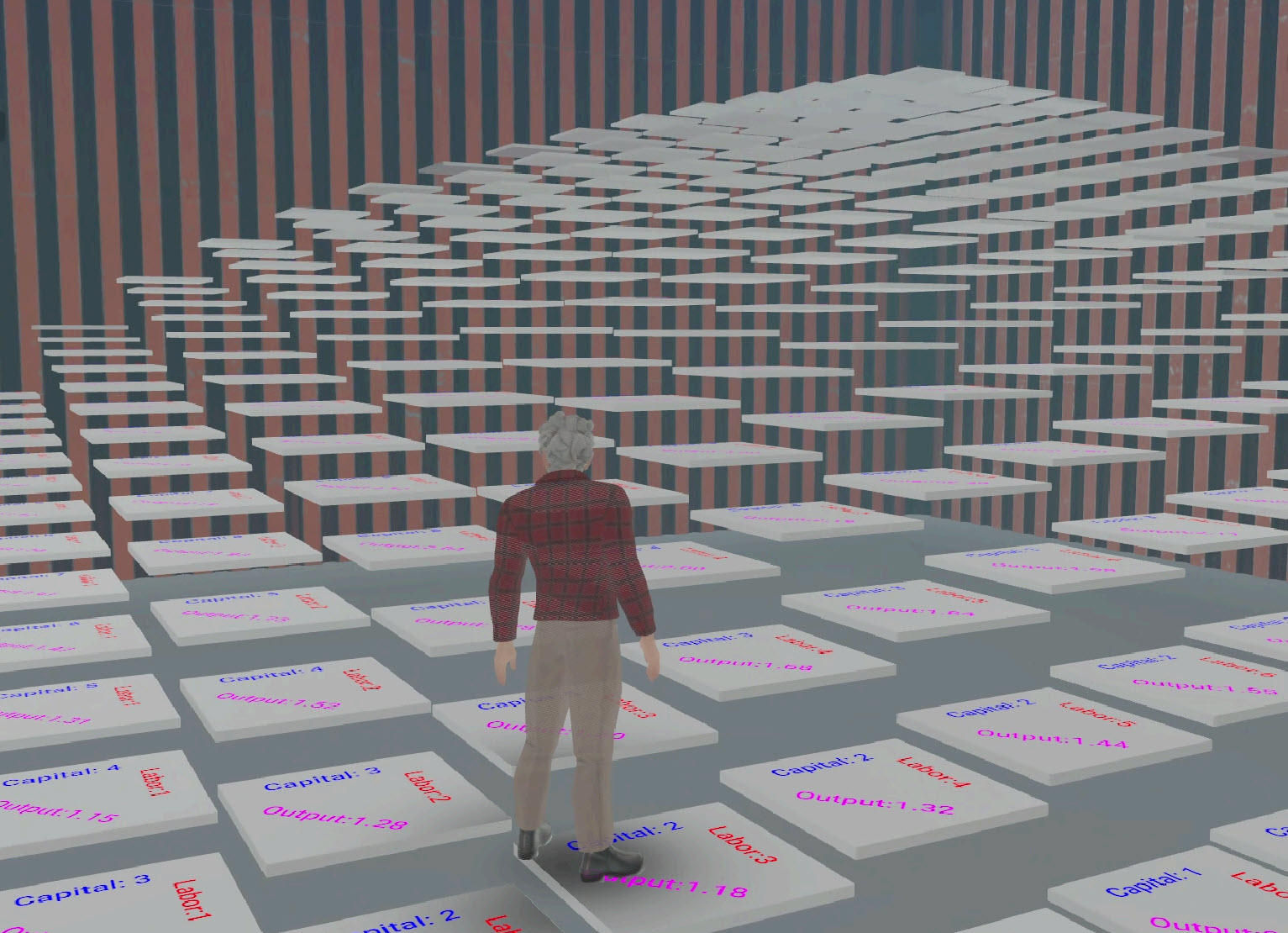
The Production Function VR apps immerses students and the instructor in a shared virtual environment where they can walk on-top of a production function with Capital and Labor at the horizontal axises and Output at the vertical axis. Each Capital and Labor input combination (integer values only) is depicted by a step. The steps form a walkable staircase.
If students walk towards more Capital or more Labor the height on the staircase, which symbolizes the Output increases. Each step is labeled with the quantities of Capital and Labor input as well as with the resulting Output quantity. While walking up and down the stairs in different directions and by exploring the staircase steps from under the staircase, students learn how increasing Capital and Labor input leads to higher Output.
The app provides several educational benefits: Immediate visual feedback strengthens conceptual understanding Small‑group VR setting with or without instructor promote peer learning and active participation. The combination of visual, auditory, and kinesthetic interaction supports multiple learning styles.
The app can be started at two entry points:
- A Linear Production Function
- A Cobb-Douglas Production Function
It is recommended to start with the linear Production Function and then walk through the door in the exhibition hall to the Cobb-Douglas production function. However, the other way around is also possible.
Using the VR App
Starting Production Function World in VR
Since the Production Function app is part of Meta Horizon Worlds it is technically a “World” rather than an app.
When using the Meta Quest headset students need to start Meta Horizon Worlds, which they can find in the* Meta Quest’s* app Library . It is titled “Worlds”.
After starting the “Worlds” application students get teleported to the “Welcome Island” where they find a big selection of different worlds. When searching for “Production Function” the Linear Production Function and the CD Production Function worlds shows up and can be started.
When teleporting is completed students will find their co-students (up to 14) and the instructor. Everybody can talk to everybody using their Meta Quest headsets. This is true in the classroom and also when students are in various locations in the real world.
Technical Preparations
The instructor should familiarize the students with how to use the Meta Quest controllers. Especially, how they can move in the virtual reality and how they use the controller like a mouse to select.
Students should be asked if they have health conditions that prevent them from using VR headsets and should be advised to stop using the headset in case they feel uncomfortable.
Accessibility:
Both, the Linear Production Function and the Cobb-Douglas Production Function app are also available in 2D in a browser. To use them a free Meta account is required. The avatar can be controlled with the keyboard`s arrow keys and the mouse. Although, not as immersive as the 3D app, the browser app is fully functional:
Teaching Strategy
Theory Preparations
Underlying Production Functions
\[\mbox{Linear Production Function: }Y=0.2\cdot L+0.4\cdot C\]
\[\mbox{Cobb-Douglas Production Function: }Y=0.5(L^{0.4}\cdot C^{0.6})\]
Traditional Teaching Approach
The theory is introduced first. Students then use the app to reinforce and verify what they have learned.
Constructivist Teaching Approach
Students initially explore the app without prior instruction and with minimal guidance from the instructor. Subsequently, they reflect on their observations in class, and the instructor helps them connect their findings to the underlying theory.
Learning Outcomes
Regardless of the teaching approach students should discover the following facts:
- Moving in the direction of more capital and/or labor increases production.
- The production increase (the step size) is larger for an extra unit of capital than for an extra unit of labor.
- When producing without labor (or without capital) with the Linear Production Function output increases when increasing capital (labor). This is not true for the Cobb-Douglas production function.
- The extra production (step size) for each extra unit of labor (capital) is always the same for the Linear Production Function. For the Cobb-Douglas function the extra output (the step size) decreases when the labor (capital) input increases.
- The same level of output can be reached with different labor/capital combinations (with different steps).
- The same output levels (steps with the same number) form a straight line for the Linear Production Function but a convex line with the Cobb-Douglas Function app.
Debriefing Phase:
After students use the app in 3D with the VR headset, the results can be discussed in class. To support the instructor reviewing the 3D app experience the 2D browser apps might be a good tool.